savvy
Savvy
Savvy is an open-world video segmentation pipeline for tracking segmentation identities across video frames. This repository also includes the accompanying Open-world Granularity-Agnostic (OGA) evaluation code, benchmark runners, and figure-generation utilities.
Demo Videos
See qualitative results for the full demo gallery.
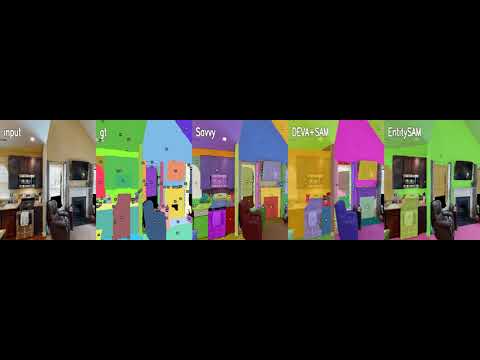
Click any thumbnail to watch the demo on YouTube.
ScanNet
| Demo | Demo | Demo | Demo | Demo |
|---|---|---|---|---|
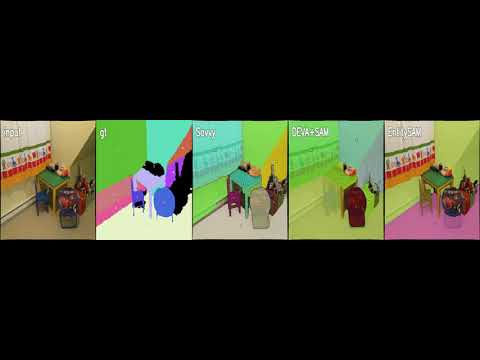 |
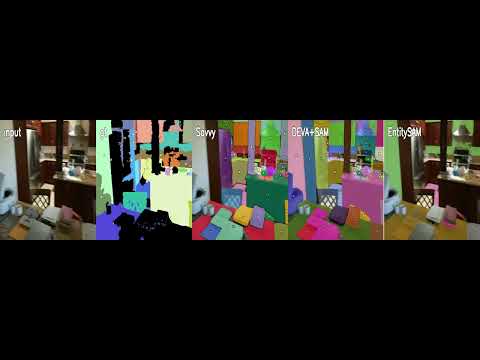 |
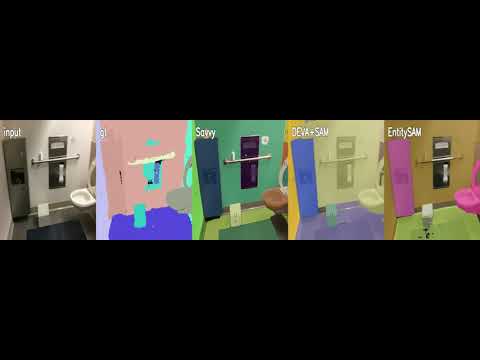 |
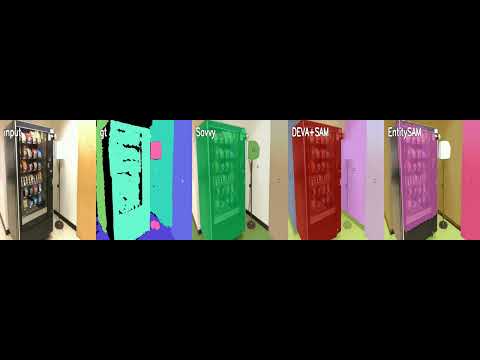 |
 |
HM3D
| Demo | Demo | Demo | Demo | Demo |
|---|---|---|---|---|
 |
 |
 |
 |
|
HM3D Trajectory Collection
In addition to ScanNet evaluation, Savvy is evaluated on a 106-scene HM3D trajectory collection generated with Habitat-Sim. The trajectories are designed to stress long-horizon open-world video segmentation: the camera moves through indoor environments, observes new objects over time, and revisits previously seen regions after large viewpoint changes.
The HM3D videos, RGB renders, instance annotations, and trajectory metadata are used by the HM3D evaluation runner in this repository. The trajectory generation and rendering pipeline is maintained as a separate Habitat-based project during development, and we plan to release it with the generated trajectory collection to support reproducible HM3D evaluation.
Qualitative Visualizations
ScanNet
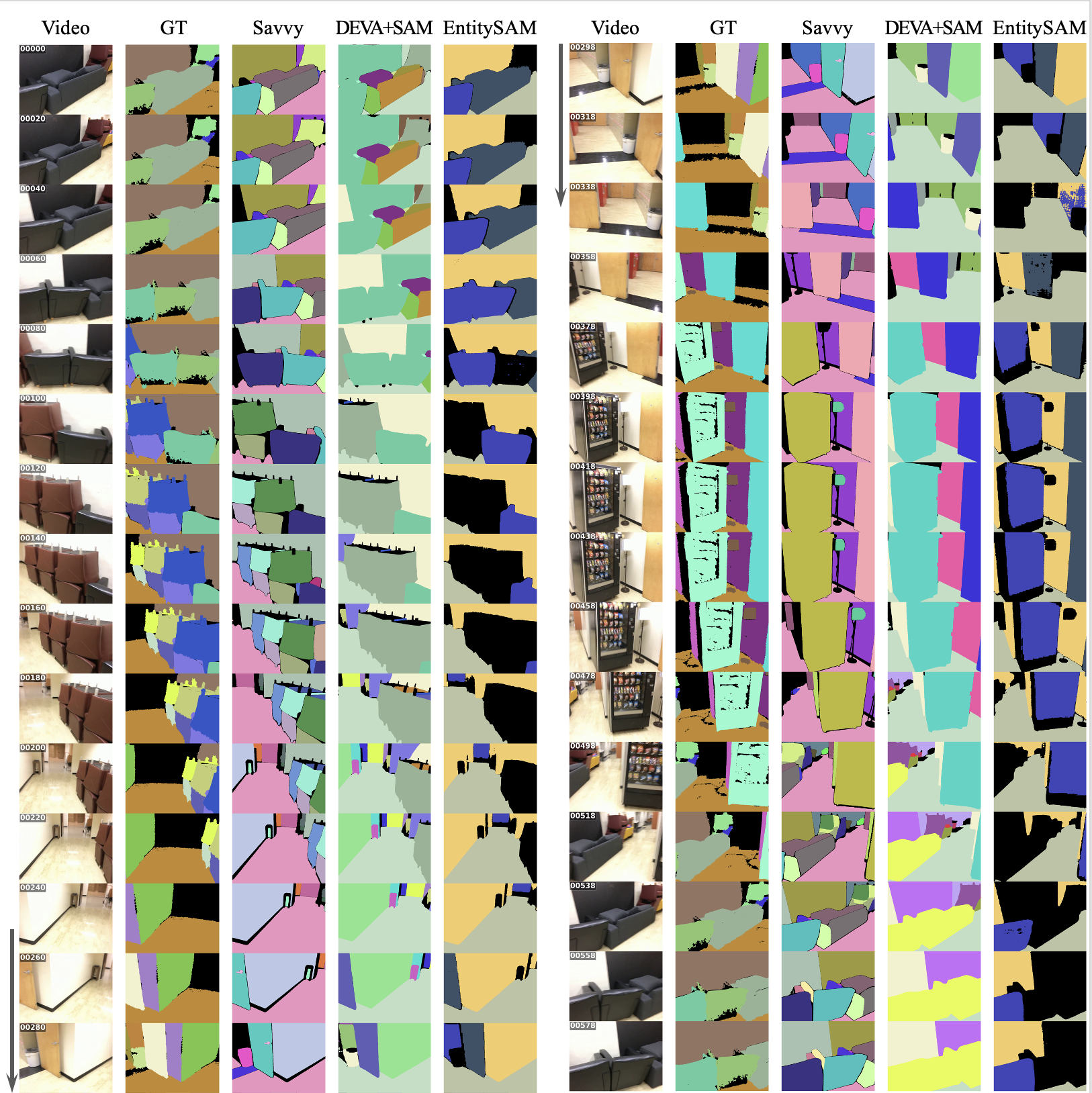
Long-horizon qualitative results on a ScanNet sequence (1). The sequence is split into two vertical blocks from left to right, following the same video over time. Early frames show couches and chairs, the camera then moves through a corridor-like region with doors, trash bins, and a vending machine, and later returns to the seating area. Savvy maintains a more detailed and consistent object decomposition across these transitions: chairs, couch regions, doors, bins, vending-machine surfaces, walls, and floor regions remain separated with relatively stable identities as the camera viewpoint changes. DEVA+SAM often produces broad foreground coverage, but local object structure is unstable: chair backs and seats blob into nearby furniture, object boundaries bleed into floors or walls, and several thin or adjacent structures are absorbed into large regions. EntitySAM produces coarse partitions with limited new-object discovery; large surfaces remain stable, but newly encountered objects such as chairs, bins, door-side structures, and vending-machine details are often missed, collapsed into background-like regions, or assigned to identities that drift from earlier objects. This example illustrates the long-horizon OVS challenge: good performance requires not only segmenting visible foreground, but also expanding the object set when new objects appear, preserving fine object boundaries, and maintaining identities when the camera leaves and later revisits the same scene regions.
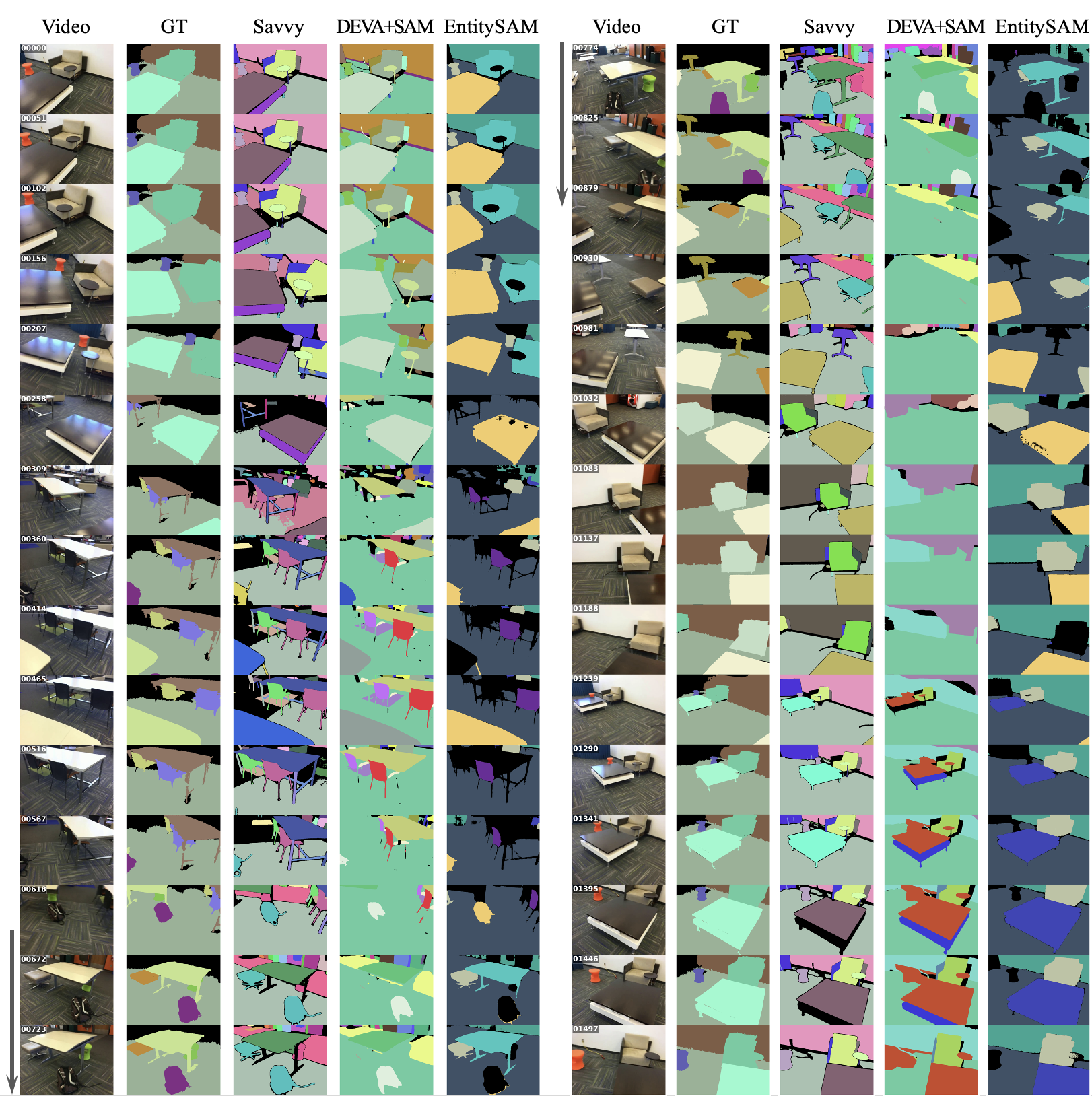
Long-horizon qualitative results on a ScanNet sequence (2). The sequence is split into two vertical blocks from left to right, following the same video over time. The camera first observes a seating/table area, then moves through a wider room region with multiple tables and chairs, and later revisits furniture from different viewpoints. Savvy maintains a more detailed and temporally consistent object decomposition across the sequence: tables, chairs, sofa/couch regions, stools, and surrounding floor/wall structures remain separated as the camera moves and revisits previously seen areas. DEVA+SAM often provides broad foreground coverage, but its local structure is unstable: nearby objects blob together, chair legs and table boundaries bleed into adjacent surfaces, and thin structures are frequently smeared or inconsistently split across frames. EntitySAM produces coarse partitions that appear stable at the surface level, but its new-object discovery is limited; newly encountered chairs, tables, and small furniture pieces are often missed or absorbed into large regions, and existing identities may drift onto visually different objects instead of creating new object identities.
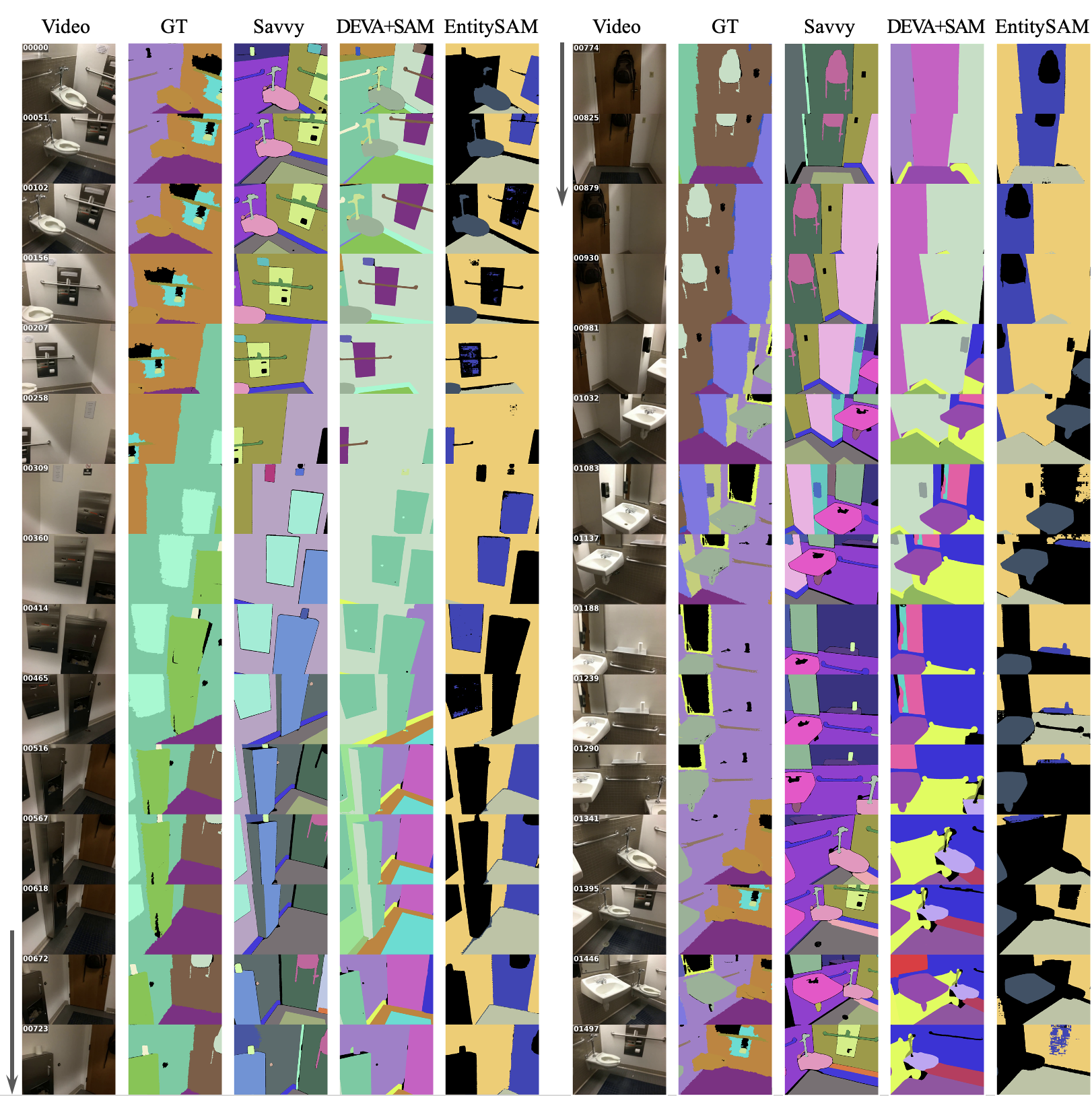
Long-horizon qualitative results on a ScanNet sequence (3). The sequence is split into two vertical blocks from left to right, following the same video over time. The camera first observes a sink, wall fixtures, counter regions, and nearby floor/wall surfaces, then turns around towards the door region with hanging backpack, and later revisits the bathroom fixtures from a different viewpoint. Savvy maintains a detailed and temporally consistent object decomposition across these large viewpoint changes: the sink basin, counter surface, wall-mounted fixtures, door, floor, wall regions, and small objects remain better separated and are re-associated when the camera returns. DEVA+SAM often segments broad foreground regions, but its local structure is unstable: sink and counter regions bleed into surrounding walls, thin fixtures are inconsistently preserved, and large wall/floor regions absorb nearby objects across frames. EntitySAM produces much coarser partitions with limited new-object discovery; large surfaces remain dominant, while small fixtures, sink details, and corridor objects are frequently missed, absorbed into background-like regions, or assigned inconsistent identities as the viewpoint changes.
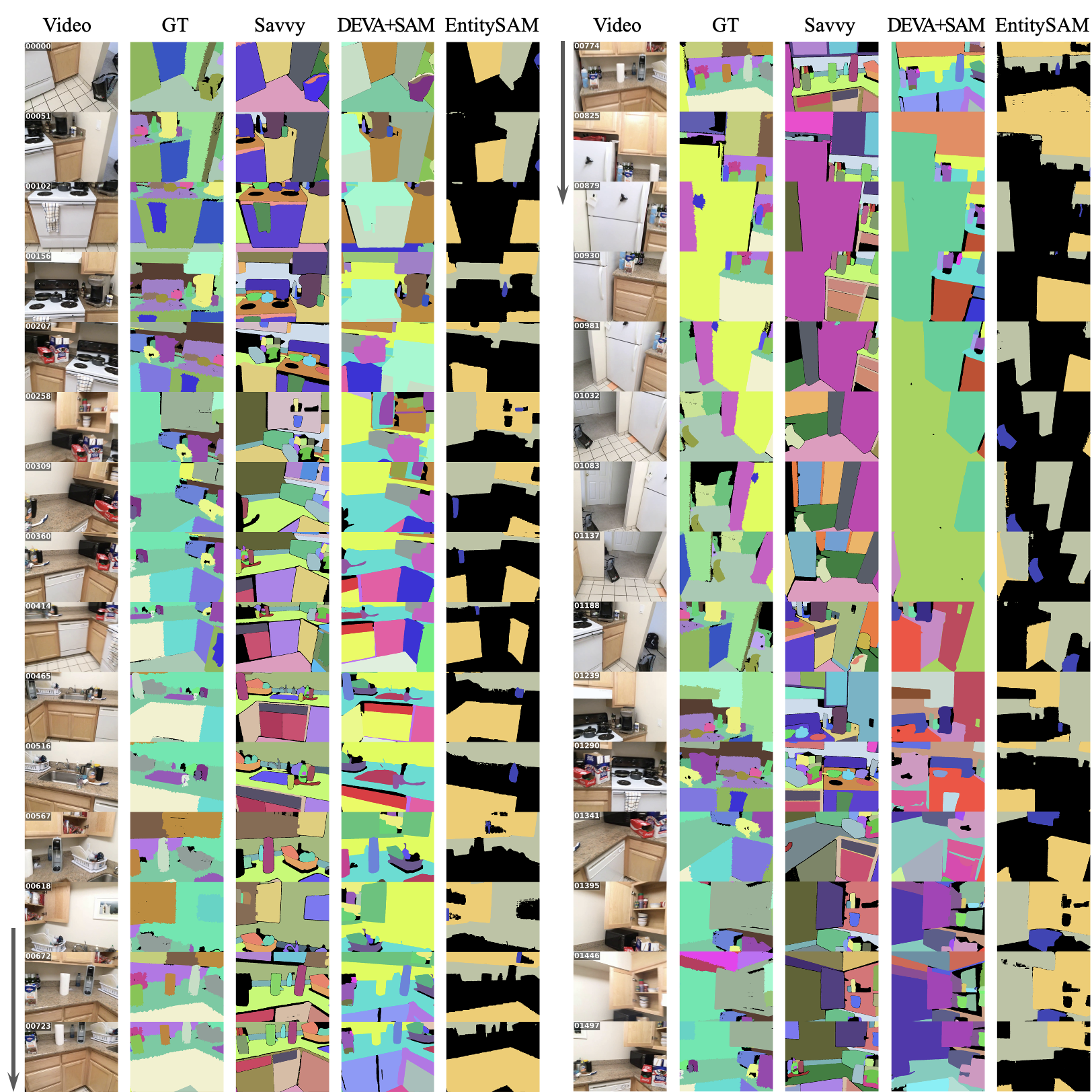
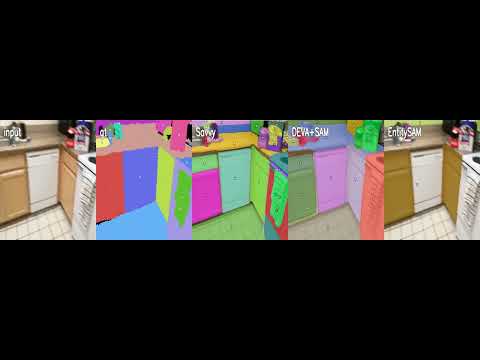
Long-horizon qualitative results on a cluttered ScanNet sequence (4). The sequence is split into two vertical blocks from left to right, following the same video over time. The camera first observes cabinets, a stove, countertop objects, and floor regions, then moves toward a refrigerator and doorway area, and later returns to the kitchen workspace from different viewpoints. Savvy maintains a detailed object decomposition in this cluttered scene: cabinets, countertop surfaces, stove regions, bottles, small kitchen items, refrigerator surfaces, door regions, and floor/wall structures remain more separated across the long trajectory. DEVA+SAM captures many foreground regions but shows frequent local bleeding and blobbing: countertop objects merge into cabinets or counters, adjacent surfaces are inconsistently split, and small objects are often absorbed into larger regions as the camera moves. EntitySAM produces much coarser partitions and limited new-object discovery; large surfaces such as cabinets, walls, and appliances dominate, while small kitchen objects and newly observed structures are frequently missed or assigned to broad existing regions.
HM3D
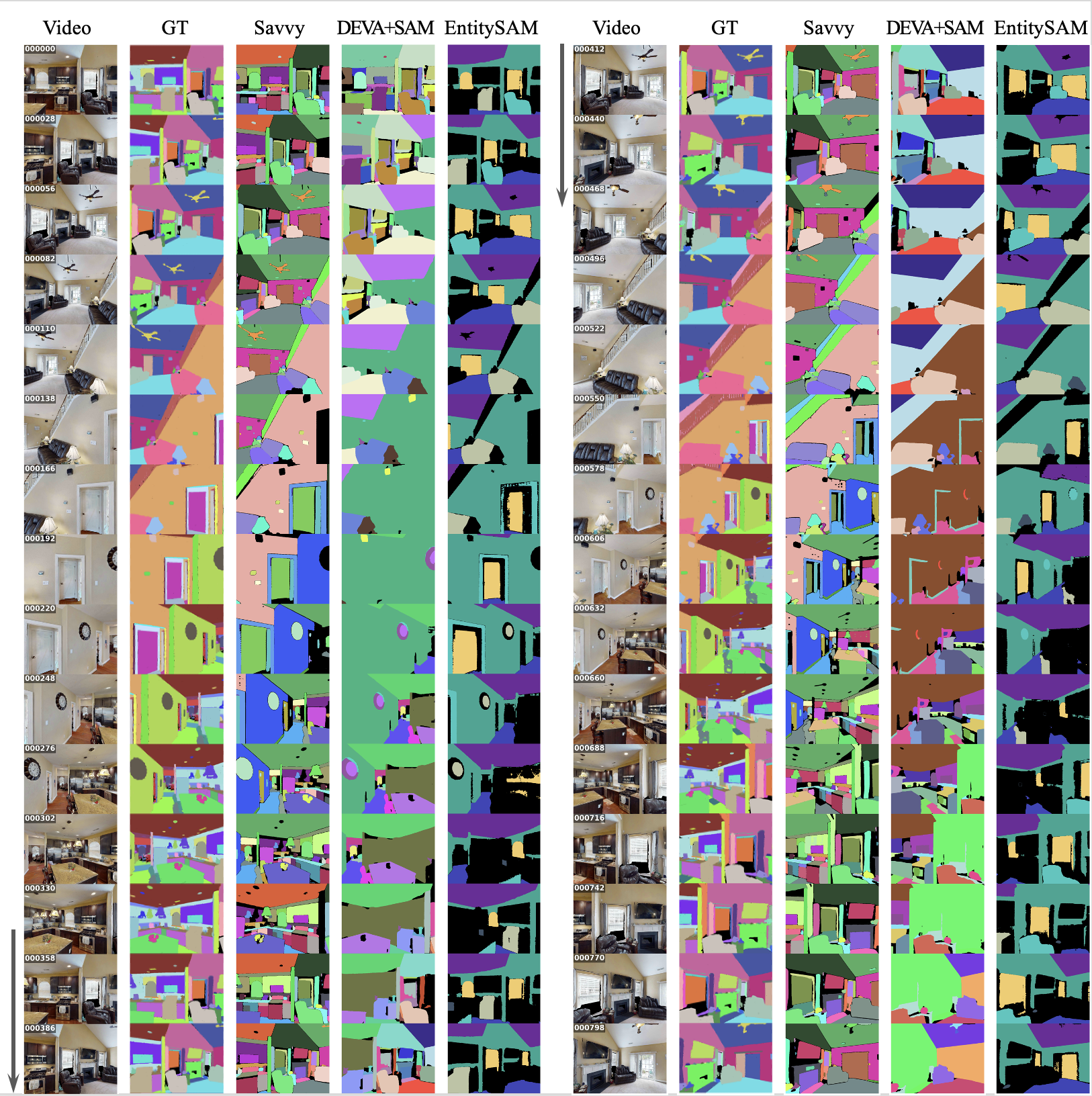
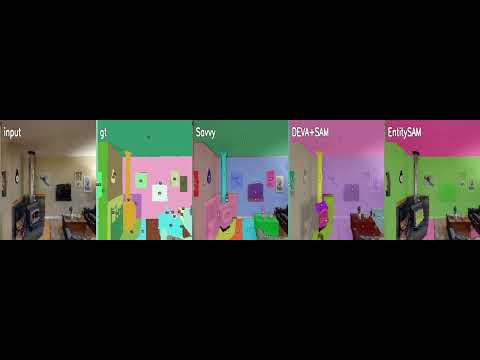
Long-horizon qualitative results on an HM3D indoor home sequence. The sequence is split into two vertical blocks from left to right, following the same video over time. The camera moves through a living-room and kitchen area with large viewpoint changes, repeated observations of furniture, walls, doors, ceiling structures, counters, cabinets, and small household objects. Savvy maintains a more detailed and temporally consistent scene decomposition across the trajectory: major room structures remain separated, while smaller objects and furniture regions are repeatedly recovered as the viewpoint changes. DEVA+SAM provides broad coverage but shows unstable local structure, with large surfaces and furniture regions frequently bleeding into one another or changing decomposition across frames. EntitySAM produces coarser partitions with limited object-set expansion; large surfaces are often stable, but newly observed furniture, cabinets, counters, and small objects are frequently missed as separate identities. This example shows that the trends observed on ScanNet also hold in HM3D: long-horizon OVS requires not only foreground coverage, but also persistent discovery, stable granularity, and re-association across repeated scene revisits.
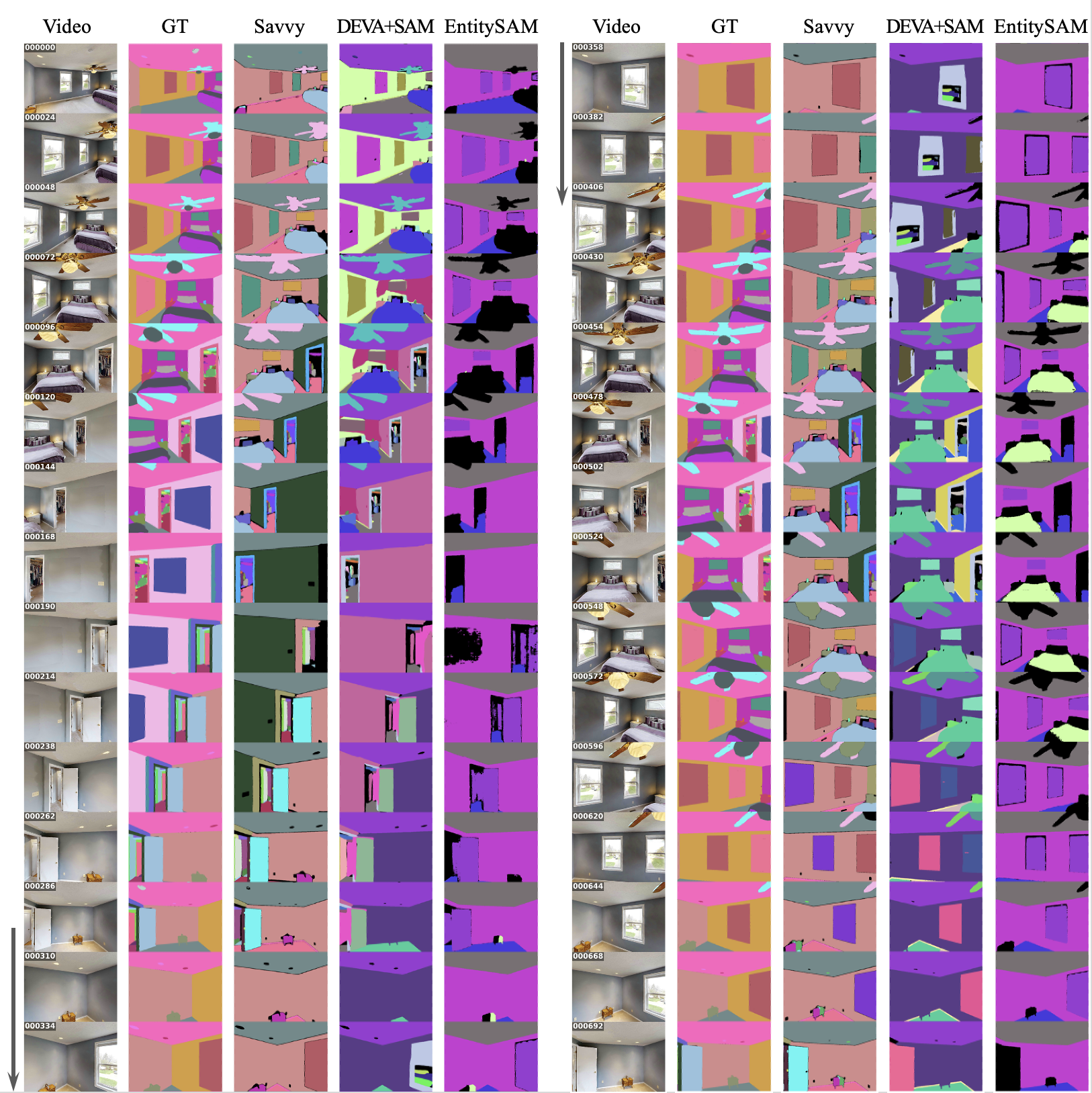
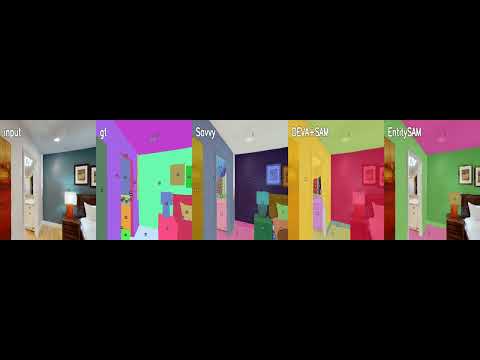
Long-horizon qualitative results on an HM3D bedroom sequence. The sequence is split into two vertical blocks from left to right, following the same video over time. The camera moves around a bedroom with repeated observations of walls, windows, doors, ceiling fan, bed, lamps, pillows, and small room objects under large viewpoint changes. Savvy maintains a relatively detailed and temporally consistent decomposition of both large room structures and smaller objects: wall and ceiling regions remain separated, while the bed, fan, door, and nearby objects are repeatedly recovered as the camera leaves and revisits the same regions. However, window consistency remains challenging for all methods; the same physical window can be rediscovered with a new identity or switch identity across revisits. DEVA+SAM provides broad coverage but shows severe local blobbing, bleeding, deformation, and unstructured fragmentation, especially around furniture, wall/ceiling boundaries, and window regions. EntitySAM produces coarser partitions with limited object-set expansion; large surfaces remain dominant, while smaller objects such as the ceiling fan, lamp, pillows, and door/window details are often missed as separate identities or absorbed into broad regions. This example further supports the HM3D trend: long-horizon OVS requires stable object-set maintenance across repeated views, not only coarse foreground coverage of large indoor surfaces.
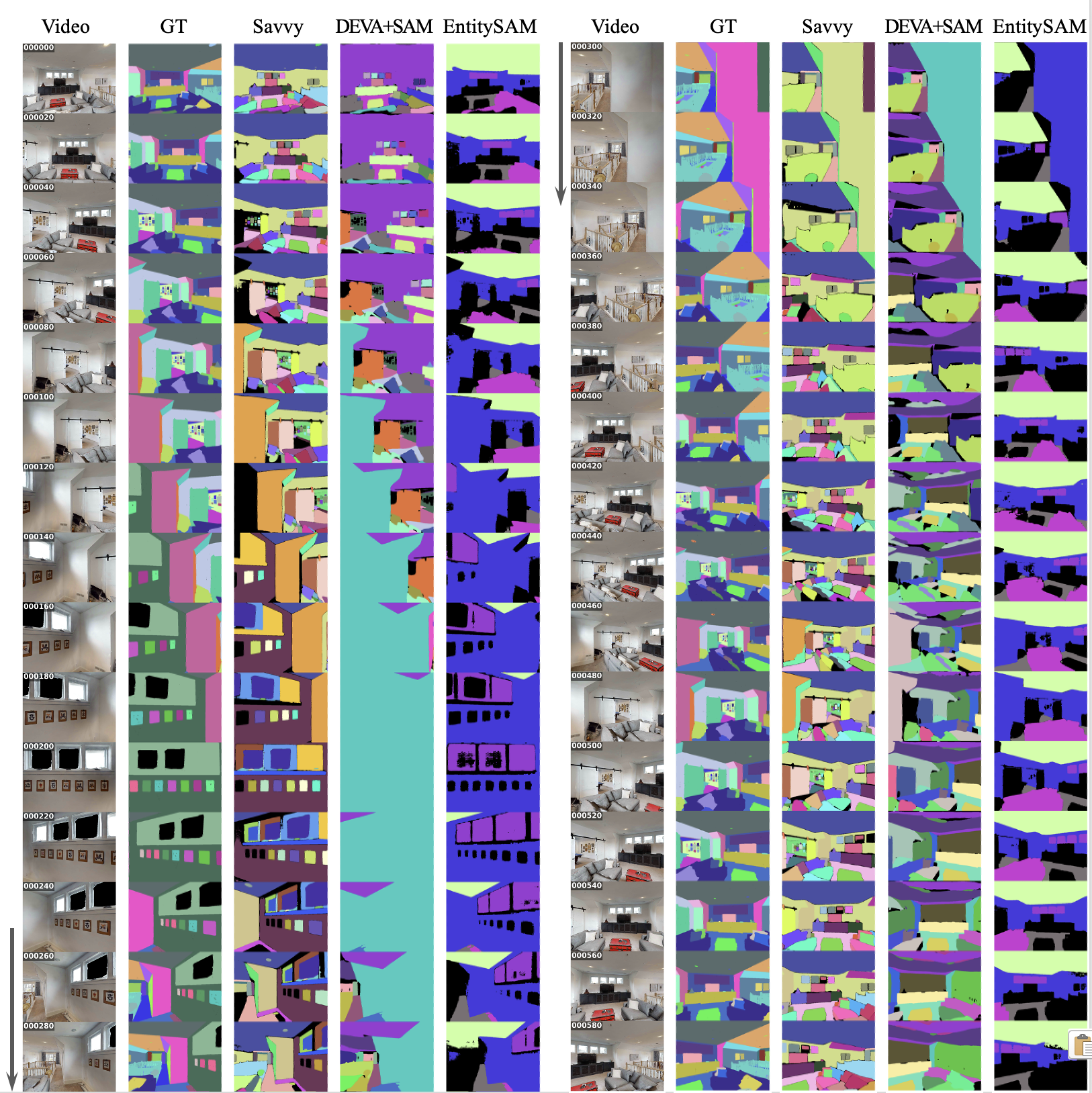
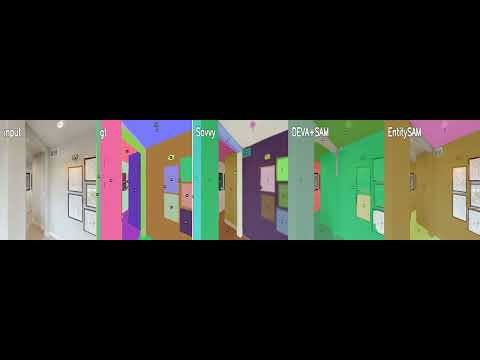
Long-horizon qualitative results on an HM3D living-room sequence. The sequence is split into two vertical blocks from left to right, following the same video over time. The camera first observes a living-room area with couches, windows, wall decorations, tables, and shelves, then moves through a stairway/corridor view before returning to the living-room region from different viewpoints. Savvy maintains a relatively detailed and temporally consistent object decomposition across these large viewpoint changes: couches, pillows, tables, shelves, framed wall objects, windows, and room surfaces are repeatedly recovered and kept more separated over time. DEVA+SAM provides broad coverage but shows strong local instability, including blobbing, boundary bleeding, deformation of furniture regions, and inconsistent fragmentation of shelves, wall decorations, and couch/table areas. EntitySAM produces much coarser partitions with limited object-set expansion; large surfaces and dominant furniture regions remain visible, but many smaller objects such as frames, pillows, shelves, and table-top items are missed as separate identities or absorbed into broad regions. This example highlights a common HM3D challenge: long-horizon OVS must preserve detailed object structure while the camera alternates between wide room views, close-up wall/shelf views, and revisits to previously observed living-room regions.
Repository Layout
savvy/: core Savvy pipeline and tracking components.inference/: generic Savvy inference for a directory of video frames.evaluation/: ScanNet, HM3D, and VIPSeg runners plus shared OGA metrics.visualization/: cleaned source modules for support matrices, behavior matrices, sequence strips, and identity-event curves.assets/visualizations/: README-facing figures and qualitative image assets.notebooks/: lightweight example notebooks that import the cleaned modules.sam2/andsegment_anything/: minimal adapted SAM2/SAM1 runtime subsets.run_*.sh: root-level launch scripts for common inference and evaluation jobs.
See VENDOR_ADAPTATIONS.md for the adapted SAM/SAM2 file list.
Setup
This code expects a Python environment with PyTorch/CUDA support and the common scientific Python stack used by SAM/SAM2 workflows:
torch,torchvisionnumpy,scipy,pandasopencv-pythonPillowmatplotlibhydra-core,omegaconf
SAM1 and SAM2 checkpoints are required. The launch scripts expose these as
SAM1_CKPT, SAM2_CKPT, and SAM2_CFG; set those paths for the local environment.
Generic Inference
Run Savvy on a directory containing an ordered sequence of frames:
./run_savvy_inference.sh /path/to/frames /path/to/output 0
Outputs:
masks/:uint16PNG instance maps.visualizations/: optional overlay images.metadata.json: frame list and inference settings.
For additional options:
python -m inference.savvy_video_inference --help
Benchmark Evaluation
The root scripts are the main entry points:
./run_scannet_eval.sh
./run_hm3d_eval.sh
./run_vipseg_eval.sh 0
Before running, edit dataset and checkpoint paths in the scripts.
The shared OGA metric implementation lives in evaluation/oga_metrics/.
ScanNet/HM3D evaluation outputs are written as oga_full_results*.json/csv.
VIPSeg evaluation outputs are written as vipseg_savvy_oga_*.
Visualization
Reusable visualization code lives under visualization/:
support_matrix_behavior_matrix.pyidentity_discovery_reassociation_events.pysequence_strips.py
A lightweight notebook with placeholder paths is available at:
notebooks/visualization_examples.ipynb
The notebook demonstrates sequence strips, support matrices, OGA behavior matrices, and reassociation-event curves.